

BIG HORN


Kurs/Position
vor 749 Tagen
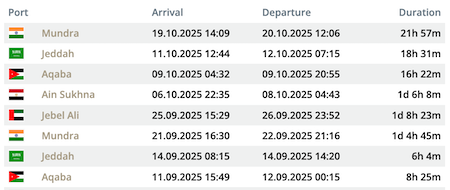
Die letzten Häfen
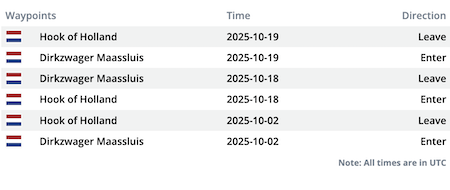
Die letzten Wegpunkte
Die neuesten Nachrichten
Investigation: US Navy oiler ran aground due to a series of poor decisions and failure to follow procedures
In the northern Arabian Sea, the commander of the USNS 'Big Horn' gave the order to take a shortcut through risky waters rather than take a longer, safer route to their destination on Sep 23, 2024. The Navy command investigation found out that the accident was caused by "a series of poor decisions, failure to follow procedure, application of open water navigation to restricted waters, and failure to exhibit proper risk calculation." It reveals that the captain and his watchstanders failed to prepare for the shortcut and failed to monitor navigation alerts that could have averted disaster at the last minute. The investigation recommended administrative or disciplinary action against Big Horn's captain and several officers. Military Sealift Command said that both the commander and the navigator were still employed. It was unclear if they will be permitted to hold their positions again. Shortly after 12 p.m. LT, the 'Big Horn' was wrapping up its final replenishment-at-sea with ships from the Abraham Lincoln Carrier Strike Group. The next move was to sail from the northern Arabian Sea to the Duqm port in Oman for a scheduled visit. The new navigator was drafting route options for the captain to get the 'Big Horn' to a pickup point, where the oiler would embark a harbor pilot to guide the ship into port. During a conversation with another officer, the transcript of which was included in the Navy's investigation, the navigator expressed concerns about running aground on a particular route and said they preferred an option through deeper water. The navigator told the officer that they could take the riskier shortcut and save time. The officer said they should present the shortcut to the captain. One route, known as Duqm A, was shorter but ran through known shoal areas. Duqm B was a "deep water" path that added several miles to the journey to the rendezvous point. Just before 12:30 p.m., with the last replenishment-at-sea ongoing, the navigator asked the captain which route they preferred. "Let's try to shoot the gap there," the captain told the navigator, selecting the Duqm A route, even though it threaded a gap between charted shoals dangerously close to the oiler's draft. The navigator said that they had checked on the under keel clearance, to which the captain replied: "Rad." There was no indication that the captain reviewed a paper chart during the decision-making process. At roughly 1:30 p.m., the 'Big Horn' completed its final replenishment-at-sea and set out for the pick-up point for the harbor pilot. The vessel sailed through the San Carlos Banks at 17 to 18 knots. In transit, the ship's system triggered safety alarms. They were silenced but had visual cues; there is no indication that they were acknowledged. Meanwhile, the ship's fathometer showed the water growing progressively shallower. At 2:12 p.m., the vessel began vibrating as it struck the sea floor. Crew members reported fuel leaks on both main engines. The damaged oiler was anchored and later towed into Duqm. Investigators found that the members of the bridge team appeared "unreasonably" focused on meeting a 3 p.m. harboir pilot pick-up time, which contributed to the decision to take the risky shortcut at high speeds. Although the captain later said he did not believe he was operating in restricted waters and was unaware of any safety hazards or navigational concerns, the investigators concluded that the Duqm A track met the definition of restricted waters under Navy policy, meaning a formal navigation brief should have been conducted before entering the area. The investigation also found that, when the 'Big Horn' ran aground, she was operating with two separate electronic navigation chart databases, and there was some confusion among the officers about which one was in use at the time. Safety contours and the shoal area were not clearly displayed. Records indicated there was music was playing on the bridge up until the grounding. Tugs brought the 'Big Horn' into port on Sep 24. The grounding caused extensive damage to the hull, internal support structures, port propeller, and port rudder. According to Navy cost breakdowns, expenses included roughly $7.5 million for towing, $8.6 million for services in Oman, $1.9 million for fuel offloading, and $2.4 million in additional costs in the US — totaling more than $20 million.
Replenishment tanker damaged when running into something
The USNS 'Big Horn', being deployed to the Middle East, suffered damage on the night of Sep 23, 2024, after apparently running into something in the Arabian Sea and suffered damage to the ship’s rudder post and water flooding into a mechanical space. No crew members were njured in the incident. The extent of the damage was still being assessed and an investigation was ongoing. The 'Big Horn' was anchored off the coast of Oman earlier on Sep 24, but commercial tugboats were deployed to tow the vessel to a nearby port. Officials did not detail the circumstances of the allision, but the incident occurred in a part of the Arabian Sea that can be crowded with small fishing boats and vessels that can make maneuvering a large ship difficult. It was unclear if the 'Big Horn' ran aground or struck an object underwater.
7 injured in Navy training accident during collision with a tanker
The US-Navy says four sailors and three civilian instructors were injured when a rigid hull inflatable boat collided with fleet replenishment oiler 'USNS Big Horn'. U.S. Fleet Forces Command said the collision occurred Monday morning (July 22, 2013) near Thimble Shoals Channel. The sailors were assigned to the amphibious assault ship USS Bataan. The instructors worked for the Center for Security Forces. The exercise was being conducted in support of a visit, board, search and seizure boat crew course involving USNS Big Horn. Two sailors and two civilians were released from a Virginia Beach hospital. One civilian and one sailor remained under observation late Monday. The fourth sailor was treated at Joint Expeditionary Base Little Creek-Fort Story in Virginia Beach. The Navy says it has launched an investigation into the collision.
News schreiben