

DALI


Kurs/Position
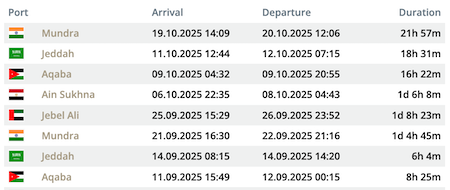
Die letzten Häfen
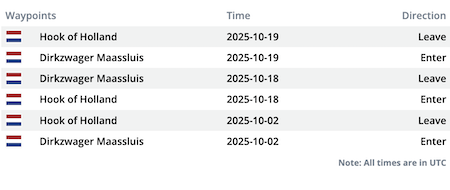
Die letzten Wegpunkte
Die neuesten Nachrichten
Dali accident the largest single loss in the history of the P&I market,
The allision of the 'Dali' with the Baltimore bridge has become the largest single loss in the history of the P&I market, with reserves now exceeding $2.8bn and the claim reaching a layer of the International Group’s insurance structure never previously tested by a casualty of this scale. Gallagher Specialty said that the reserve associated with the 2024 destruction of Baltimore’s Francis Scott Key Bridge was likely to rise further. The casualty has generated claims from government agencies, infrastructure owners, businesses, cargo interests and victims’ families. The 'Dali' loss has now moved into the International Group’s collective overspill reinsurance protection, effectively pushing beyond the conventional group excess-of-loss programme applicable to the casualty year. Around $300m of purchased overspill protection remained available on rounded estimates, meaning shipowner members have not yet been hit with an overspill levy. More than two years after the casualty, physical the construction of Baltimore’s replacement Francis Scott Key Bridge was underway. Crews are driving permanent piles, building an over-water construction trestle and removing remaining sections of the old bridge and marine foundations. The replacement features a 1,665 ft cable-stayed main span, around 230 ft of vertical clearance and substantially greater separation and protection around the navigation channel. The project has, however, become far larger and more expensive than first envisaged, with the current cost estimate at $4.3bn-$5.2bn and completion now targeted for late 2030.
Court dismissed many economic losses claims
The district court in Maryland, hearing the civil portion of the claims related to the 'Dali' destroying Baltimore’s Francis Scott Key Bridge, ruled on Aug 25, dismissing many of the economic loss claims while also letting several claims proceed. The court up until this point had declined to decide on issues related to a 1927 U.S. Supreme Court ruling that had limited economic losses only to claimants that had a direct property interest in the damaged property, in this case the Key Bridge. Among the claims being issued was one from Star Bulk that argued the carrier’s ships were unable to reach the loading berth in Baltimore harbour because of the bridge collapse and, as such, it lost profits or earnings potential. Also dismissed was a class consisting of longshoremen who lost work, an insurance syndicate and Ports America Chesapeake, American Sugar Refining, and a large group of businesses and individuals, including a yacht sales company and American Publishing, that said the blocked harbor and loss of the bridge interfered with their business. The owner of the 'Dali', the Grace Ocean, and the manager, the Synergy Marine, had filed at least since October 2024 to block the economic claims that were seeking recovery damages, citing the 1927 case, Robins Dry Dock & Repair Company. Additionally, in April 2024, they filed a motion that sought to invoke the Shipowners’ Limitation of Liability Act of 1851 as it related to the economic claims. Judge James K. Bredar wrotw in his opinion that the Robins Dry Dock decision had “loomed large over these proceedings.” He also noted that there is nearly a century of case law that has interpreted and applied Robins and developed clear exceptions. The court moved to decide the application of Robins after it was agreed in June to delay the remaining claims. The companies and their insurers settled key elements of the civil claims, including all the wrongful death and personal injury claims, and the claims from the state of Maryland. All but 10 of the 54 initial claims filed in the civil case have been settled or voluntarily dismissed. At issue was the 1927 U.S. Supreme Court decision that bars economic loss recoveries caused by negligence unless there were also physical damages to properties. Most of the remaining claims cite economic losses due to the closure of the port and the loss of the bridge. In Robins Dry Dock, the propeller of a vessel was negligently damaged while undergoing scheduled maintenance and delayed the vessel’s return to operation for two weeks. A suit was brought to recover for the lost profits while the vessel was out of operation, and was rejected when it reached the Supreme Court. In the 75-page opinion, the judge considered each of the claims against the Robins decision and subsequent exceptions that have been established in case law. The decision let several claims survive and proceed. Included in this is one from the City of Baltimore for damages to a water main that was in the harbour below the bridge, while the court dismissed other claims from the city related to the loss of the bridge and damage to other streets and bridges. The court said that the City of Baltimore had failed to establish a proprietary interest in the Key Bridge sufficient to license recovery of the economic damages beyond the physical damage to the water main. A claim for Baltimore County was also permitted to survive specifically for damages to the county’s waterways. The county claims debris from the bridge reached its shoreline, and the court let those claims stand, but dismissed claims similar to the city regarding roadways. The final claim that survived was a class action filed by the trucking company R.E. West, which alleges physical damage to cargo from various companies aboard the 'Dali'. A portion of the claim from West was dismissed, but the elements specific to damage of cargo resulting from the allision and the collapse of the bridge onto containers survived. The judge noted in his conclusion that the plaintiffs had asserted that Robins would be transformative to the civil claims against the 'Dali', and the court agreed. It noted that the scope of the civil case has been significantly narrowed. It was likely the decision in this case will also further add to the case law in the century since the Supreme Court’s Robins Dry Dock & Repair decision.
Deferred prosecution agreement with chief engineer
The federal prosecutors have reached a deferred prosecution agreement with the chief engineer of the 'Dali', with the veteran Indian mariner admitting to conduct constituting a criminal violation of the Ports and Waterways Safety Act for failing to report a known hazardous condition aboard the vessel before its allision with Baltimore’s Francis Scott Key Bridge. The agreement, announced on June 19 by the U.S. Attorney’s Office for the District of Maryland, marked the first admission of criminal wrongdoing by an individual directly involved in operating the vessel during the accident. Deenadayalan admitted that he had been aware that the 'Dali' and two sister ships, the 'Maersk Saltoro' and the 'Cezanne', were operating with an unsafe fuel supply arrangement that lacked redundancy and could impair the vessels’ ability to recover from a power loss. The vessels used a flushing pump as part of their fuel supply system even though it was not designed to automatically restart following a blackout. Deenadayalan admitted he understood that the lack of redundancy posed a hazard to the safe navigation of the vessels and could endanger bridges, structures and shore facilities, yet failed to report the condition to the U.S. Coast Guard as required by law. The deferred prosecution agreement allowed the prosecutors to suspend criminal prosecution provided Deenadayalan complies with the terms of the agreement. The criminal information filed against him alleged a violation of the Ports and Waterways Safety Act, though the prosecutors emphasised that criminal charges remained allegations unless proven in court. The agreement also shed additional light on the communications between Deenadayalan and Radhakrishnan Karthik Nair, a Synergy technical superintendent who was indicted in May alongside two ship management companies. Deenadayalan admitted that Nair directed him to send a “convincing” email to the vessel’s charterer regarding the 'Dali'‘s fuel consumption to avoid drawing attention to the use of the flushing pump. The admission was closely tied to the broader criminal case unveiled in May against Singapore-based Synergy Marine Pte Ltd., Chennai-based Synergy Maritime Pvt Ltd., and Nair. The federal prosecutors alleged that the defendants knowingly operated the ship with unsafe modifications that contributed to the blackout sequence. According to the indictment, the 'Dali' had suffered two power losses within four minutes while departing Baltimore Harbor. Investigators believe a loose wire in a high-voltage switchboard triggered the initial blackout. However, prosecutors allege the vessel’s backup systems had been altered in a way that undermined critical redundancies. At the center of the case was the flushing pump, which allegedly was improperly used to supply fuel to two diesel generators despite not being designed to automatically restart after a blackout. As a result, the generators lost fuel supply following the first outage, leading to a second blackout that left the vessel without propulsion or steering moments before impact. The allegations aligned with thr findings from the investigation by the National Transportation Safety Board, which concluded that an improperly secured signal wire triggered the initial electrical failure aboard the vessel. Separately, the shipbuilder HD Hyundai Heavy Industries has alleged that the vessel’s operators bypassed built-in redundancies after delivery by replacing automatic fuel supply pumps with the non-redundant flushing pump, a modification the company said violated classification rules and contributed directly to the second blackout. The broader criminal case remained pending. The defendants, including the two Synergy companies and Nair, have denied wrongdoing and were presumed innocent unless proven guilty in court. The case was being investigated by the Federal Bureau of Investigation, the Coast Guard Investigative Service, and the Environmental Protection Agency Criminal Investigation Division.
News schreiben