

LNG MERAK


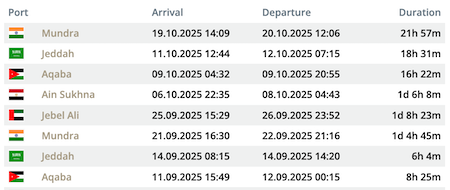
Die letzten Häfen
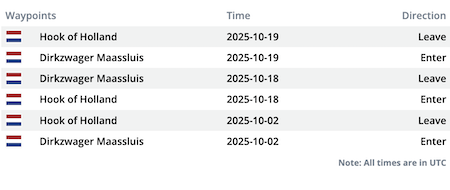
Die letzten Wegpunkte
Die neuesten Nachrichten
LNG carrier with Russian gas entered Mediterranean Sea two weeks after destruction of Arctic Metagaz
On March 14, 2026, the 'LNG Merak', carrying Russian LNG, has entered the Mediterranean Sea for the first time since Moscow began diverting shipments away from the region after an explosion destroyed the LNG carrier 'Arctic Metagaz'. The 'LNG Merak' passed through the Strait of Gibraltar and was now heading northeast along the Spanish coastline. In the immediate aftermath of the explosions aboard the 'Arctic Megagaz', Russia had started directing LNG carriers transporting its gas away from the Mediterranean and the Suez Canal, apparently to keep them beyond the perceived operational range of Ukrainian maritime drones. Several vessels changed course as a result. At least five tankers commonly linked to Russia’s “shadow fleet” of LNG carriers were rerouted away from the Mediterranean, instead heading for the Cape of Good Hope. Some ships made mid-voyage U-turns, while another LNG tanker continued to wait off Port Said at the northern entrance to the Suez Canal rather than continuing into the Mediterranean. The arrival of the 'LNG Merak' suggested that these precautionary measures could be easing, although the vessel differed significantly from the ships that were diverted earlier. Unlike the 'Arctic Metagaz', which had been sanctioned by the United States and the European Union and widely viewed as part of Russia’s growing fleet of opaque LNG carriers, the 'LNG Merak' was operating under conventional commercial arrangements. The ship is flagged in Hong Kong and managed by Japan’s Mitsui O.S.K. Lines (MOL). Neither the vessel nor its operator iwas s subject to U.S. or EU sanctions, though MOL had three other LNG carriers temporarily blocked by the EU in 2025. It was also transporting cargo from the long-established Yamal LNG project in the Russian Arctic rather than the heavily sanctioned Arctic LNG 2 development. The 'LNG Merak' received its cargo on March 6 via a ship-to-ship transfer with the ice-class tanker 'Vladimir Vize' near the Kildin anchorage off Murmansk. The transfer occurred three days after the explosion of the 'Arctic Metagaz'. It was not immediately clear where the 'LNG Merak' was intending to discharge its cargo, as the vessel was not signaling a destination. However, Spain was considered the most likely destination. The incident involving Arctic Metagaz highlights the growing risks faced by vessels linked to Russian energy exports as the war in Ukraine spills into maritime trade routes. Whether LNG Merak’s passage signals a broader return of Russian LNG shipments to the Mediterranean remains to be seen.
News schreiben