

MSC DENMARK VI


Kurs/Position
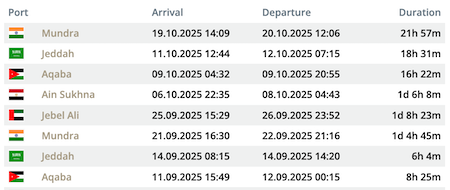
Die letzten Häfen
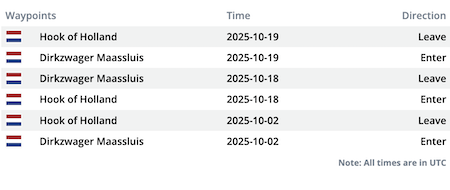
Die letzten Wegpunkte
Die neuesten Nachrichten
Oil spill in Antwerp caused by hole in the hull
The 'MSC Denmark VI', which caused a massive oil spill in the Port of Antwerp on April 9, had a hole in its hull. This was confirmed on June 5 by the Port of Antwerp-Bruges. The port authority paid a bill running into the millions of euros and hoped to recover that amount later. Following the oil spill, the Commercial Court of East Flanders (the spill occurred in the Beveren-Kruibeke-Zwijndrecht area) had launched an investigation. The Nautical Commission has been working on the case for months. It turned out that the ship had a large hole in its hull—damage presumably sustained in another port abroad. The hole in the hull was situated above the waterline, making it—in itself—harmless. However, when the ship arrived in Antwerp, the waterline shifted. As the 'MSC Denmark VI' sailed into the port on the evening of April 9, its waterline dropped. This was due, in part, to the transition from saltwater to brackish water. The ship also settled slightly lower in the water due to its heavy cargo. This was followed by a bunkering operation, which likely caused the hole in the hull to suddenly expand, allowing oil to leak out. Other contributing factors included the tides and poor visibility. It was already nighttime, meaning the leak went unnoticed for several hours. Once the leak was detected, however, the port authority responded with great speed. Consequently, it appeared there was no major human error involved. The Port of Antwerp-Bruges spent millions of euros on the entire operation. All claims combined wee likely to exceed 50 million euros. The ship left Antwerp again only on April 25.
Leakage still causing nuisance in Antwerp
The oil leak originating from the 'MSC Denmark VI' in the Deurganckdock in Antwerp was still causing nuisance and environmental damage.. On April 187 almost a week after the oil leak, the terminals in the Waaslandhaven were operational again. The leakage had caused severe disruption to shipping traffic and economic damage during the first few days after the incident, which, could amount to ten million Euros or more. Natuurpunt and the Civil Protection were still busy cleaning up oil on both banks of the Scheldt in a race against time. Because during spring tide, which was expected on the night of April 19 or April 20, reed beds where many birds breed on both bankswere threatened to be polluted. It was also a waiting game for the' MSC Denmark VI'. If all goes well, the ship will be taken to EDR Antwerp Shipyard this week for repairs. As of April 20, it remained stationary in the Deurgangdock.
Oil threatened nature reserves
For the time being, Rijkswaterstaat could do little about the oil pollution from the 'MSC Denmark VI' entering Zeeland waters and nature reserves from the Port of Antwerp. Drones, aircraft, and ships could only see a very thin film of oil floating on the water. At the request of the Belgian authorities, Rijkswaterstaat (RWS) had dispatched several vessels towards the Western Scheldt. This included the oil spill response vessel 'Arca', which arrived from Scheveningen, the buoy tenders 'Scheldestroom' and 'Frans Naerebout', as well as the patrol vessel 'RWS 78'. However, the 'Arca' can only collect oil if the oil layer has a certain thickness. The ship uses sweeping arms to scoop oil from the water, but the layer was too thin. It would have mainly sucked up water instead of oil. The focus of the Dutch authorities has now shifted to the protection of the Zeeland nature reserves. There was daily contact between Rijkswaterstaat, Het Zeeuwse Landschap, and the local authorities. The 'RWS 78' was underway every day to monitor the developments. The RWS Coastguard aircraft flew around twice to view the situation in Zeeland from the air. It has special equipment on board to detect and assess oil. A drone team was also deployed. Rijkswaterstaat was collaborating with the Hydro Meteo Centre (HMC), which attempts to predict how substances in the water move, using complex models, which are fed with data such as wind direction, wind speed, and the tide. The mechanical cleaning that has started on the Flemish side at Galgenschor was being closely monitored in the Netherlands to determine whether a similar operation was also necessary and possible in Saeftinghe in the middle of the breeding season. After the rust spot on the hull of the container ship, which remained stationary in Antwerp as of April 14, cracked due to the pressure during refueling, heavy fuel oil leaked out, which was viscous and has a density close to that of brackish water, causing the oil to move partly below the water surface. In the Port of Antwerp, locks and other vessels became contaminated. In the adjacent nature reserves, oil ended up on the mudflats and salt marshes.
News schreiben