

REGINA-K


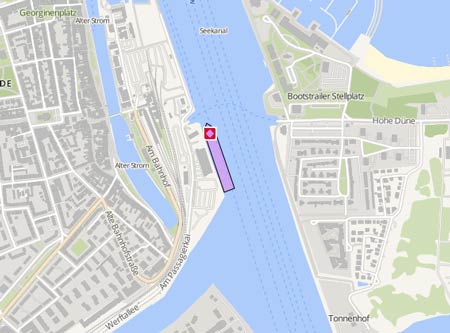
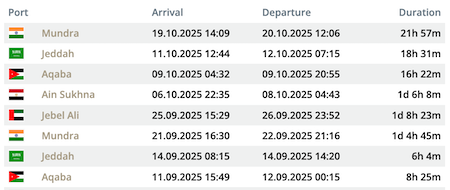
Die letzten Häfen
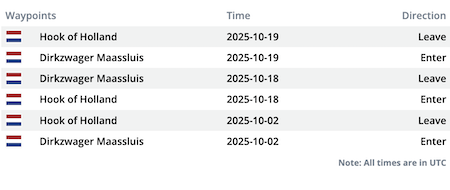
Die letzten Wegpunkte
Die neuesten Nachrichten
Government plans stricter regulations for TGAIN after accident in Müden
After the allsion of the 'Regina K' with the Müden lock on the Moselle on Dec 8, 2024, the German government wants to introduce strict regulations for the use of the "Track Guidance Assistant for Inland Navigation" (TGAIN). The damage was totaling more than five million euros. In May, the ship's master received a fine from the St. Goar District Court for negligently endangering shipping traffic. According to the penal order, he was steering the vessel with the track guidance assistant until four seconds before the allision and entered the lock's outer harbour at an unreduced speed of 13 km/h. A TGAIN makes it possible to specify a precise route on a river. The Stuttgart-based company Argonics, whichoffers the system under the name "Track Pilot" and also equipped the 'Regina K', strongly recommend deactivating the Track Pilot before entering a lock. Furthermore, the vessel's speed must still be adjusted manually. It remains unclear why the ship's master did not intervene in the accident. Investigators have ruled out a technical defect. TGAIN systems have only been in widespread use in recent years. Since November 2023, the German federal government has been subsidizing their acquisition by up to 80 % of the costs. The aim is to improve the competitiveness of "higher-emission modes of transport" and reduce the "risk of shipping accidents," according to the Directorate-General for Waterways and Shipping (GDWS), which reported to the Federal Ministry of Transport. The European Committee for the Drawing Up of Standards in Inland Navigation (CESNI), a specialist body with experts from EU member states and the inland navigation sector, estimated that – as of July 2024 – approximately ten % of all vessels operating on the Rhine were using a TGAIN. Duisburg expert Marco Reinhart investigated the accident near Müden for the authorities. According to him, there were several accidents at the beginning of the year in which a TGAIN was used. In addition to the Müden case, the accident at the Iffezheim Rhine lock in Nov 2023 is currently being investigated. To date, the use of TGAIN devices is neither nationally nor internationally regulated. The GDSW now wants to change this and introduce requirements that are to be incorporated into the German Inland Waterways Regulations. This includes the obligation to employ trained personnel and to deactivate such systems in the vicinity of locks. A watch alarm is also required. Insurers also require such a device. The Argonics TrackPilot already has a watch alarm integrated, but that can in principle be deactivated. The accident in Müden was used as an opportunity to implement a software update. If the skipper does not actively deactivate the TrackPilot before entering a lock, an alarm will sound. The "Federal Association of Self-Employed Inland Waterway Operators," which represents individual self-employed entrepreneurs, rejects the federal government's planned regulations.
Ship was sailing at a speed of 12,2 km/h and on autopilot, when it crashed
The allision of the 'Regina K' with the Moselle lock in Müden happened while the ship was on autopilot, when it sailed into the lock at high speed. Analysis of the recorded data shows that the ship entered the lock at a speed of 12.2 kilometers per hour. The public prosecutor's office confirmed that semi-autonomous driving with autopilot is generally permitted on the Moselle on the condition that the ship's master can intervene at any time. The authorities were still investigating why this did not happen in this case. Investigations had showed that neither the engine nor the ship's controls had any technical defects. In addition, no evidence of alcohol or drug consumption by the responsible captain was found. Video recordings showed that the ship continued to sail at high speed until the impact,which destroyed the lock gate. The public prosecutor's office is still investigating why the ship's captain did not intervene. Possible human errors or a misassessment of the situation were the focus of the investigation.
First ship passed through repaired lock
The Moselle lock in Müden was back in operation on Feb 1, with the first ship being the "Mainz", a ship used by the Waterways and Shipping Authority (WSA), which successfully passed through the lock on the morning. Representatives of the state and the Directorate General for Waterways and Shipping came to the reopening of the lock along with Federal Transport Minister Volker Wissing and representatives from Luxembourg and France were also present. According to the WSA Rhein-Mosel-Saar, the repair of the lock has been fully completed. The last test locks were still running until the afternoon of Jan 31. The gate movements were checked again and finer details were adjusted. The experts paid attention to the hydraulics and whether the speed of the 40-ton gate wings was programmed correctly. The work was carried out at record speed. The 'Regina K' remained in Haren as of Feb 4. Report with photo and video: https://www.tagesschau.de/inland/regional/rheinlandpfalz/moselschleuse-wieder-frei-100.html
News schreiben