

SIYANIE SEVERA


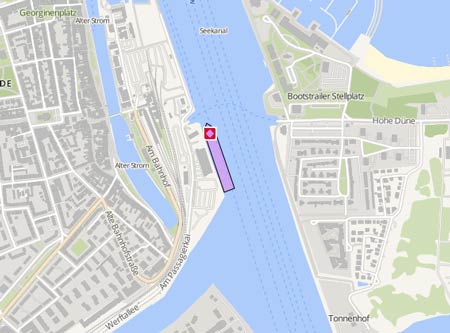
Kurs/Position
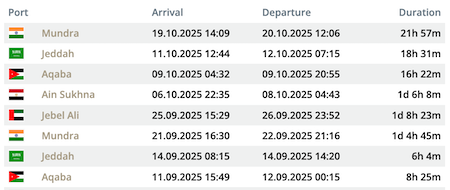
Die letzten Häfen
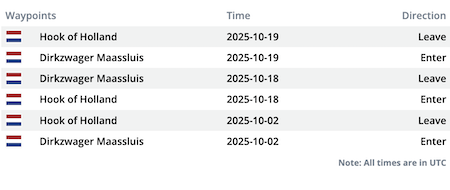
Die letzten Wegpunkte
Die neuesten Nachrichten
Russia caught shipping weapons and suspected spies to Africa aboard civilian cessels
Russia has been using civilian cargo vessels in order to transport military equipment and suspected undercover intelligence operatives to Africa, with 28 persons believed to have traveled under fabricated identities aboard vessels carrying supplies for Russian military operations. According to a joint investigation published on Oct 19, 2026, by the Dossier Center, Follow the Money, Süddeutsche Zeitung, Danwatch, and Delfi, the suspected operatives sailed aboard on the whole seven Russian cargo vessels with military equipment, which was primarily intended for Russia’s Africa Corps, a Defense Ministry-controlled formation that replaced the Wagner mercenary group. The names, dates of birth, and identity document numbers of these people could not be found in publicly available records or leaked databases. They were likely Russian intelligence personnel operating under cover identities. The investigation found that the passengers used Russian passports without biometric chips. Several documents differed only in their final digits, while two carried consecutive numbers, suggesting they may have been issued together as part of a coordinated operation. The documents displayed characteristics associated with passports used in intelligence operations. Analysts at US-based security research organization C4ADS also concluded that the passengers’ personal information appeared to have been fabricated. One of the shipments involved the 'Sabetta' (IMO: 9347061), which arrived at the port of Conakry on March 19 and delivered approximately 50 military and support vehicles, including armoured vehicles and fuel tankers. The equipment was subsequently transported overland to Mali, where Russia’s Africa Corps maintains a military presence. Four passengers aboard the 'Sabetta' had identity details that investigators could not verify through other available records. The vessel is owned by Severny Proekt, a Russian company involved in state defense contracts and special projects for the state nuclear corporation Rosatom. The investigation also identified three roro vessels, the 'Adler' (IMO: 9179854), 'Ascalon' (IMO 9198226) and 'Baltic Leader' (IMO: 9220639, which were operated by the MG-Flot, a Russian shipping company sanctioned by the USA and European Union over activities linked to Iran and supplies supporting Russian drone production. Three additional cargo vessels, the 'Mikhail Britnev' (IMO: 9081370), 'Mys Zhelaniya' (IMO: 9366110) and 'Siyanie Severa' (IMO: 9250385), were also identified as part of the maritime network. The 'Siyanie Severa' had previously transported grain from temporarily occupied Ukrainian territories. The vessels frequently switched off their AIS transponders during voyages to Africa, making their movements more difficult to track. Russia may have deployed personnel from the Federal Security Service (FSB) or military intelligence agency (GRU) to accompany the shipments because of the sensitive military cargo. The suspected intelligence operatives could have been tasked with monitoring crews and preventing vessels from complying with potential orders to stop issued by European authorities. Approximately 15 Ukrainian drone specialists have been operating in Mali, providing training and operational support to local forces fighting Russia’s Africa Corps. Ukrainian personnel have also conducted drone operations in Sudan and Libya, targeting Russian-linked military and maritime activities. Report with photos: https://united24media.com/world/russia-caught-shipping-weapons-and-suspected-undercover-spies-to-africa-aboard-civilian-vessels-23571
Russian military convoy enroute to Mediterranean
Russia's military has military equipment for export again. On April 30, a military convoy consisting of three freighters and a frigate was observed for the first time in the Baltic Sea. The "Jiaganghangbeng 01" had the Russian Navy's flag flying from its mast. The Russian frigate "Boikiy" used the Chinese name to camouflage itself and escort the Russian heavy-lift carriers "Baltic Leader," "Patria," and "Siyanie Severa." The freighter convoy is fully loaded. More than 10,000 tons are on board, as the draft suggests. The convoy set off on the evening of April 29 from the Russian naval port of Baltiysk in Kaliningrad, Russia's largest military depot on the Baltic Sea. Its destination is the Mediterranean. The Danish Navy and the GErman Federal Police have been shadowing the convoy since that day. The task force vessel "Bamberg" followed the "Boikiy" from Rügen through the Kadet Trench and the Fehmarn Belt. The NATO will also be closely monitoring the convoy in the coming weeks. The convoy is the largest Russian military transport in the Baltic Sea since January 2022, when six landing ships left the Baltic Sea with equipment for the Ukraine campaign and headed for the Black Sea. The last convoy sent from the Baltic Sea to the Mediterranean was in December, with the heavy-lift freighters "URSA Major" and "Sparta." The "URSA Major" sank during the voyage after an explosion off the Algerian coast on Dec 23. The destination could be Libya. Russia is currently very active in the Sahel region. From bases in Libya, they can expand their influence in the region. Satellite images have shown construction activities since February at the Libyan military airport Maaten al-Sarra, which has been closed since 2011. The military base is strategically located in the Sahel region. From there, deliveries of military equipment to Sudan, Niger, Chad, and Burkina Faso are easily feasible. The use of these roll-on/roll-off vessels suggests that Russian military vehicles are also being transported. The deployment of so much equipment raises the suspicion that the war in Ukraine is no longer a priority. In 2024, a large portion of the military equipment retrieved from Syria was also sent to Ukraine.
Russian military convoy shadowed during transit through waters of NATO countries
A Russian naval force consisting of four ships was close to rounding Skagen Reef on the afternoon of March 19, 2025, heading towards the Great Belt. The Royal Navy, along with NATO allies, had conducted a coordinated operation to monitor the Russian naval task group since entering the English Channel on March 16. The Type 23 frigate HMS 'Somerset', the minehunter HMS 'Cattistock' and the RFA 'Tidesurge' had participated in the monitoring operation, which began south of Portsmouth. The operation involved both naval assets and aerial surveillance, including a RAF P8 Poseidon maritime patrol aircraft from RAF Lossiemouth. The ships were on their way back from Syria, where they have picked up military equipment that is no longer needed after the Russian-backed President Assad's regime fell in Dec 2024. The ships have been continuously shadowed by aircraft and warships from the NATO countries they have passed, a task that was taken over by units from the Danish Navy when the naval force have passed Skagen. The convoy consisted of the destroyer 'Severomorsk', the landing craft 'Aleksandr Shabalin', and the cargo ships 'Sparta IV' and 'Siyanie Severa', both of which sailing for the Russian Navy. The naval force was on its way to St. Petersburg with the 'SParta IV' having an ETA as of March 24, where equipment from Syria has previously been brought ashore. The Russians are negotiating with the new rulers in Syria for permission to continue using the strategically important naval base in Tartus. The Russians are prepared to pay for the base with Russian oil. The status of these negotiations was unknown. Report with photos: https://www.royalnavy.mod.uk/news/2025/march/19/250319-royal-navy-shadow-russian-task-group-returning-from-syria-in-the-channel
News schreiben