

THANH DAT 86


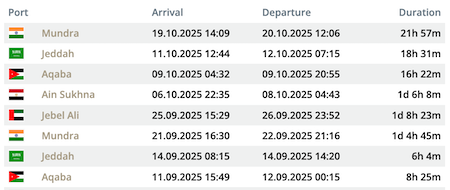
Die letzten Häfen
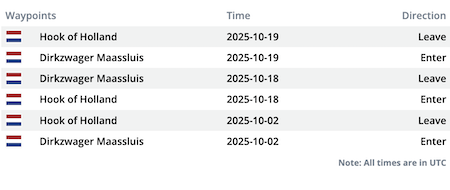
Die letzten Wegpunkte
Die neuesten Nachrichten
Bridge temporary suitable for operation under restricted conditions
On March 12, the Saigon Railway Joint Stock Company announced that it had sent a document to the Vietnam Maritime and Inland Waterway Administration, the Southern Inland Waterway Sub-Department, and the Dong Nai Provincial Traffic Police Department requesting restrictions on waterway traffic across the second half of the Ghenh Bridge, which had been damaged by the 'Thành Đạt 86'. The Vietnam Railways Corporation reviewed the load-testing conditions and, in accordance with the plan of the Inspection Advisory Unit, conducted a load test of span number 2 of the Ghenh Bridge. The results of the load tests indicated that span 2 of the Ghenh Bridge, after reinforcement, was suitable for temporary operation under restricted and controlled conditions. On the morning of March 11, the first train had crossed the Ghenh Bridge at a speed of 5 km/h, and subsequent trains traveled at a speed of 15 km/h. After temporary repairs were carried out to allow shipping to pass, the construction equipment on Span 2 was removed to avoid disrupting the shipping channel below. However, the structure of Span 2 remained in critical condition due to the structural instability caused by the allision and has only been temporarily reinforced. The Saigon Railway Joint Stock Company therefore requested that the relevant authorities continued to regulate and reroute shipping traffic to restrict passage over Span 2 of the Ghenh Bridge. At the same time, the pedestrian walkway on the Ghenh Bridge should remained closed until the completion of the repair and restoration work and the bridge is reopened. Local authorities instructed emergency services in the area to continue implementing measures to ensure traffic order and safety in the Ghenh Bridge area. At the same time, entering the area where the Ghenh Bridge was being repaired, was strictly prohibited and would be punished. Report with photos: https://www.vietnam.vn/de/ket-cau-nhip-cau-ghenh-bi-sa-lan-va-cham-khong-on-dinh-han-che-tau-luu-thong
Trains crossing Ghenh Bridge again
On March 11 at approximately 9:00 a.m., freight train H4501 officially crossed the Ghenh Bridge (Bien Hoa District, Dong Nai Province), marking the first resumption of transport operations on the north-south railway line after more than five days of disruption caused by a allision of the 'Thành Đạt 86' with the bridge. The train, consisting of 22 cars with a total weight of 962 tons, traveled from north to south. Officials from the Vietnam Railway Corporation and technical units monitored and coordinated the verification of technical parameters before the train passed under the bridge. Following the train's passage, authorities continued to measure track deviations, inspect the bridge structure, and verify safety parameters. Initial findings indicated that the track and bridge structure were essentially stable, thus ensuring the provisional operation and readiness for subsequent trains. At approximately 9:40 a.m. that same day, passenger train SE6 also crossed the Ghenh Bridge in a south-north direction, marking the resumption of freight and passenger traffic on this important railway line. Initially crossings were permitted at a maximum speed of 5 km/h to ensure absolute safety during the initial phase of resuming operations. The technical parameters were within acceptable limits. Freight and passenger trains were now permitted to resume service across the Ghenh Bridge, and the North-South Railway line has officially reopened On the afternoon and evening of March 10, teams had conducted load tests on the Ghenh Bridge to determine its structural integrity and thus decide whether service could resume. According to Vietnam Railways Corporation, the resumption of train service across the Ghenh Bridge a day earlier than originally planned on March 12 helped minimise the impact on rail traffic in recent days. The fabrication and installation of new girders at the section of the N2 bridge was continued. The projected implementation time is approximately 60 days from the date the plan was approved by the relevant authorities. Report with photos: https://baophapluat.vn/thong-tau-tro-lai-qua-cau-ghenh-sau-su-co-sa-lan-va-cham.html
Repair plan develöped for damaged Ghenh Bridge
According to the Ministry of Construction, the total damage caused by the allision of the 'Thành Đạt 86' with the Ghenh Bridge (Dong Nai Province) amounted to approximately VND 40 billion as of March 9,, and was expected to rise to around VND 140 billion by March 20,. On March 9, a delegation from the Ministry of Construction, led by Vice Minister Nguyen Danh Huy, visited the bridge at kilometer 1699+860 of the Hanoi-Ho Chi Minh City railway line in the Bien Hoa district of Dong Nai Province. Representatives from the Dong Nai Provincial People's Committee, the Vietnamese Railways Administration, the Vietnamese Maritime and Inland Waterways Administration, the Vietnamese Railway Company, and other relevant institutions also participated in the meeting. The purpose was to assess the extent of the damage and discuss solutions for resolving the incident as quickly as possible. On March 6 at approximately 10:17 a.m. the 'Thanh Dat 86' with captain Mr. Pham Thanh Binh, carrying a cargo of 3,339 tons, aollided with the fifth section of the second span of the bridge, while sailng upstream. The violent impact caused deformation and bending of the bridge's steel truss structure, damaging numerous gusset plates, breaking several bridge bearing bolts, displacing the bridge bearings by approximately 25 mm, and warping the bridge rails by approximately 320 mm. Railway workers were working at full speed to repair the damaged Ghenh Bridge in order to restore north-south rail traffic as quickly as possible. Immediately after the incident, railway authorities closed the Bien Hoa-Di An section of the line to ensure the safety of the train traffoc. At the same time, safety measures were organised and the accident site secured. The barge was removed at around 11:00 am. An emergency team was also established on site, comprised of experienced engineering firms and construction companies specializing in railway bridges. These teams conducted inspections and condition assessments of the structure and developed several repair plans to ensure structural safety and resume train service as soon as possible. Three repair options were considered. The first option involves dismantling the damaged bridge span N2, relocating bridge span N3 to its position at N2, and installing three temporary bridge spans. With this option, train traffic is expected to resume after approximately 25 days at a reduced speed of 5 km/h. Subsequently, the new girders will be manufactured and installed to fully restore the bridge to its original structural condition. This process was estimated to take about 60 days. The second option was to divert shipping traffic onto Bridge N1, construct temporary berths, and reinforce Bridge N2 to ensure safe navigation. The estimated time until shipping traffic can resume is approximately 15 days. Following this, new girders will be installed to fully restore the bridge. The third option involved temporarily reinforcing the deformed girders in spans 4, 5, and 6 of span N2 with 8-meter-long I-beams connected by high-strength plates and bolts, combined with reinforcing welds at the girder nodes to increase the structure's load-bearing capacity. After thorough analysis, the on-site steering committee opted for the third option, as it ensured both train safety and the fastest possible resumption of rail service. According to the plan, if implemented smoothly, the railway line across the Ghenh Bridge could be temporarily reopened to trains on March 12 before 10:00 a.m. with a minimum speed of 5 km/h. The incident significantly disrupted transport operations on the North-South Railway. Immediately following the incident, the railway industry was forced to suspend passenger and freight services on the Bien Hoa-Di An section, leading to adjustments in the timetable for the entire line. In passenger transport, two Thong Nhat passenger trains and six regional trains have to be cancelled daily. By the morning of March 8th, over 10,000 tickets had already been cancelled, an average of about 2,000 per day. The railway also organised a passenger transfer by coach between Bien Hoa and Di An stations, transporting approximately 9,000 passengers in 23 trains. Additionally, 18 transfer trains were deployed from Saigon station to Di An station to minimise disruption for passengers. In freight transport, three freight train services and two regional freight trains have to be canceled daily, resulting in a decrease in the daily freight volume of approximately 6,000 tons. Freight transport by was is also incurring significant costs for the railway industry. The initial preliminary cause of the allision was a violation of river navigation regulations by the captain of the barge. The deputy minister requested that the Dong Nai Provincial People's Committee coordinated with the relevant authorities to cooperate with the owner of the vessel involved in the accident to determine responsibility and the amount of compensation. The deputy minister specifically requested that the police considered launching a criminal investigation to clarify responsibility. Report with photos: https://www.vietnam.vn/de/chot-phuong-an-sua-chua-cau-ghenh-sau-vu-sa-lan-tong
News schreiben