

URSA MAJORverschrottet


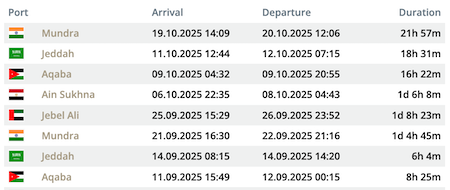
Die letzten Häfen
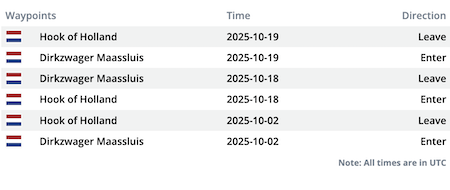
Die letzten Wegpunkte
Die neuesten Nachrichten
Inspection of wreck demanded ue to concerns that nuclear components may have been on board
The authorities of Murcia have officially demanded that the Spanish Ministry of Defense conduct a technical inspection of the 'Ursa Major' due to concerns that nuclear components may have been on board. The region’s president, Fernando López Miras, sent a letter to Defense Minister Margarita Robles demanding comprehensive information about the details of the incident and calling for an inspection of the vessel for hazardous materials. The official representative of the Murcia government, Marcos Ortuño, reported that since the sinking of the vessel, which belonged to the Russian company Oboronlogistika, the regional authorities have not received a single explanation from central government agencies. According to him, the lack of transparency and information was cause for serious concern, especially considering the nature of the cargo and possible risks to the environment and the safety of the region’s residents. The authorities of Murcia insisted that the Spanish government had to provide detailed information on the causes and circumstances of the wreck, as well as on the measures taken after the incident. In the letter sent to the Ministry of Defense, the need to rule out the presence of any nuclear components on board was emphasised. The regional government also expressed dissatisfaction that, despite numerous requests and concerns, no official inspection of the vessel has yet been organised. In January 2025, representatives of the People’s Party already raised this issue in Congress. However, the government’s response merely noted that the Directorate General of Merchant Shipping and local authorities had been informed of the situation.
Investigation suggests Ursa Major was carrying nuclear reactors for submarines in North Korea when it sank
The 'Ursa Major' was likely carrying two nuclear reactors for submarines, possibly destined for North Korea on its last voyage, an investigation has found. The ship set sail just two months after Kim Jong Un had sent troops to assist with Moscow’s invasion of Ukraine. US nuclear “sniffer” aircraft have flown over the sunken ship twice iin 2025. The wreckage was also visited a week after it sank The vessel, also known as 'Sparta 3' and a veteran of Russia’s military campaign in Syria – where it was used to evacuate Russian equipment – docked in the fuel port of Ust-Luga in the Gulf of Finland on Dec 2, 2023, before moving to a container facility in St. Petersburg’s docks. The ship’s public manifest said it was bound for Vladivostok, when it departed on Dec 11, carrying two large manhole covers, 129 empty shipping containers, and two large Liebherr cranes. The ship moved down the French coast, before Portuguese Navy aircraft and vessels tracked it through their waters. The two Russian military ships 'Ivan Gren' and 'Aleksandr Otrakovsky' escorted the vessel, and on the morning of Dec 22, the Portuguese navy dropped the tail. About four hours later, in Spanish waters, the ship slowed dramatically, prompting Spanish rescuers to radio and check if it was in distress, according to the Spanish government investigation, carried out by the local maritime authorities in the southern port of Cartagena. The ship’s crew replied that it was fine. About 24 hours later, the ship deviated sharply from its course and, at 11:53 a.m. UTC on Dec 23, issued an urgent call for help. It had suffered three explosions on its starboard side, likely near its engine room, that killed two crew members, Second Mechanic Nikitin and Mechanic Yakovlev,. This left the vessel listing and disabled. , The 14 surviving crew members evacuated on a lifeboat, and were later picked up by the SAR boat 'Salvamar Draco'. At 7:27 p.m., a Spanish military vessel arrived to assist. But half an hour later, the 'Ivan Gren' ordered nearby vessels to keep two nautical miles away, and later asked to return the rescued crew immediately. Salvamento Marítimo insisted they had to conduct a rescue operation, and sent a helicopter to the ship to check for survivors. A rescuer tried to enter the ship’s engine room, but found it sealed. The Spanish rescuer checked the living quarters for survivors, and peered inside the containers to see two filled with trash, fishing nets and other equipment The 'Ursa Major' appeared to be stable and unlikely to sink soon. At 9:50 p.m. the 'Ivan Gren' fired a series of red flares over the scene, and four explosions followed. Four similar seismic signatures were registered at that exact time, in that approximate area, the pattern of which resembled underwater mines or overground quarry blasts. At 11.10 p.m., the 'Ursa Major' had sunk. The 14 Russian survivors were brought ashore in the port city of Cartagena, where they were debriefed by Spanish police and investigators. The Russian captain Igor Anisimov was reluctant to speak about the ship’s alleged contents, fearing for his safety. He came “under pressure to clarify what he meant by ‘manhole covers,’ the items originally listed on the ship’s manifest. He finally confessed that they were the components of two nuclear reactors similar to those used by submarines. According to his testimony, and without being able to confirm it, they did not contain nuclear fuel. He believed he would be diverted to the North Korean port of Rason to deliver the two reactors. The Spanish investigation analysed the unlikely choice of a round-the-world trip to deliver a cargo of two cranes, 100 empty containers and two large manhole covers, sailing from one Russian port to another, despite the extensive rail network that spans the country. The investigation suggested the cranes were aboard to assist delivery of a sensitive cargo on arrival in Rason. The ship’s crew was returned to Russia days later. Four days after the sinking, the ship’s owner, Oboronlogistics, described it as a “targeted terrorist attack” and said there were three blasts. A 50 cm by 50 cm hole was found in the vessel’s hull, the damaged metal facing inwards. The deck of the vessel was strewn with shrapnel, the company stated. One week later, the Russian military returned to the scene. The 'Yantar', officially a Russian research ship, but accused of espionage and disruption in NATO waters , sat over the 'Ursa Major'’s position for five days, before four more explosions were detected, possibly targeting the remains of the ship on the seabed. In its statement to lawmakers, the Spanish government said the remains of the 'Ursa Major' were resting at a depth of about 2,500 meters. A recovery of its data recorder from that depth was not possible without significant technical resources and risks. The US military has also shown an interest in the area, twice sending a WC135-R aircraft based in Nebraska, over the scene of the incident, once on Aug 28, 2025, and again on Feb 6, 2026. Another WC135-R took a relatively similar flightpath 13 months before the 'Ursa Major' sank, suggesting interest in the area may have pre-dated the sinking, or be routine. The claim that North Korea was the likely recipient of the two reactors allegedly aboard the ship came after the regime released images in Dec 2025 of its first nuclear submarine. The still pictures only showed the sealed hull of the vessel, and no evidence there is a functioning nuclear reactor inside. The investigation stated that it was likely the reactors transported were the VM-4SG model, often found in Russia’s Delta IV class ballistic missile nuclear-powered submarines, but provided limited evidence to support the claim. The investigation proposed the 50 cm by 50 cm hole in the hull would likely have been made by a Barracuda supercavitating torpedo. Only the United States, a few NATO allies, Russia and Iran were believed to have this kind of high-speed torpedo, which fires air ahead of the weapon to reduce the drag of the water. The use of such a device would fit with the size of the hole in the 'Ursa Major'’s hull, and that it could have made a noiseless impact resulting in the sudden slowing of the boat on Dec 22. Multiple Western security and intelligence officials have described the incident as strange or suggested some of the Spanish investigation’s conclusions were far-fetched, but have not provided an alternative, benign explanation, for the initial blasts that hit the boat, or the acute Russian reaction to its plight. Report with photos: https://edition.cnn.com/2026/05/12/world/a-russian-ship-sank-in-mysterious-circumstances-it-may-have-been-carrying-nuclear-reactors-to-north-korea
Russian ship that sank off Cartagena was transporting nuclear reactors
The mysterious sinking of the 'Ursa Major' on the night of December 23-24, 2024, 60 miles off the coast of Cartagena, has been the subject of numerous conspiracy theories since its connection to the Russian dark fleet came to light. However, more than a year later, the combination of new information and the government's response to a parliamentary question from the People's Party (PP) has allowed for a clearer picture to emerge. The 'Ursa Major' had departed from the Russian port St. Petersburg bound for Vladivostok on Dec 11, 2024, with an ETA as of Dec 22. 11 days later, while the ship was in waters between Spain and Algeria, it drastically reduced its speed. On Dec 23, the vessel issued a distress signal after three explosions were recorded in the engine room. The Spanish authorities responded to the rescue in accordance with international law. Upon arrival, Salvamento Marítimo confirmed that the ship was listing heavily and taking on water, and that the crew had abandoned ship in a lifeboat. In total, 14 of the 16 crew members were rescued alive, while the 2nd engineer and the oiler remained missing to this day. The tanks contained 380 tons of heavy fuel oil and the same amount of diesel. The captain, Igar Vladimirovich, stated that the cargo consisted of 129 empty 40-foo containers, five 20-foot containers with spare hatch covers, two Liebherr cranes, and two clamps for an icebreaker under construction, raising the question why a ship wozld travel halfway around the world to transport empty containers and parts that could be shipped by road or rail, saving a lot of money and tim. The investigation carried out indicated that the cargo ship was carrying two blue packages weighing approximately 65 tons each. This mysterious undeclared cargo would justify a journey of more than 15,000 kilometers by sea between St. Petersburg and Vladivostok," the investigation stated, given that the Russian city was located near the border with North Korea. From there, the investigation began to narrow down the true nature of the cargo. The Spanish authorities detected items that did not match the declared manifest, such as pipes, modules, and other components typical of nuclear propulsion systems. The hypothesis that ultimately prevailed in internal reports suggested that these packages actually corresponded to the casings of two VM-4SG model nuclear reactors, historically associated with submarines. This conclusion was connected to the geopolitical context in which the incident occurred. Months earlier, Russia and North Korea had strengthened their military cooperation for an exchange of weapons and sensitive technology. The possible use of the 'Ursa Major' to transport nuclear components to the North Korean port of Rason, near the Russian border, would place the case within the realm of proliferation and international sanctions. However, the official response from the Spanish government introduced important nuances. In its response to the Congress on Febr 23, 2026, following a request for information from the People's Party a month earlier, the government confirmed that the ship's captain eventually admitted to have transported components for two nuclear reactors similar to those found in submarines, although, according to his testimony, without nuclear fuel. The government also acknowledged that a thorough inspection of the cargo was not carried out. The intervention of Spanish resources was limited to the rescue of the crew, as the ship was on the high seas and any inspection would have violated the United Nations Convention on the Law of the Sea. Another key point confirmed is Russia's rapid intervention in the operation. Hours after the distress call, a Russian warship took over the rescue operations because the 'Ursa Major' was a Russian-flagged vessel and requested that the Spanish units remain two miles away, thus limiting the scope of direct action for the resources deployed by Spain. However, on Dec 25, 2024, the Russian news agency RIA Novosti reported that the Ursa Major had been the victim of a “terrorist act.” She was among the most important vessels of Oboronlogistics, the shipping company under the Russian Ministry of Defense responsible for strategic transport to enclaves such as the temporary occupied Crimea, Kaliningrad, the Arctic, and the Kuril Islands. Built in Germany in 2009 under the name 'Scan Britania', the ship changed names several times and operated under different flags throughout its history. At the time of its sinking, another merchant ship from the same company, the 'Sparta', was sailing in the area before continuing its voyage to Port Said.
News schreiben