

ARGOS GEORGIA


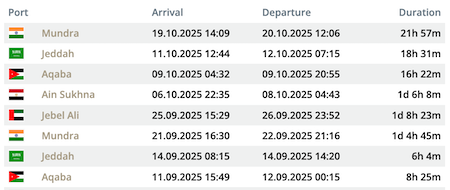
Latest ports
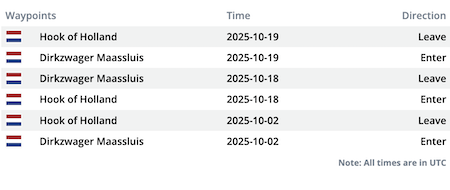
Latest Waypoints
Latest news
MAIB published report about loss of longliner
The UK’s Marine Accident Investigation Branch (MAIB) has concluded that the rescue operation following the sinking of the 'Argos Georgia' was delayed by nearly two hours. The report highlighted failures in emergency preparedness and identifies a need for a lower threshold for issuing Mayday calls, better drills for flooding scenarios, and stricter requirements regarding side hatches and safety equipment. The rescue operation was delayed by nearly two hours, according to the final accident report from the UK’s Marine Accident Investigation Branch (MAIB), published on Sep 25, 2026. The longliner sank on July 22, 2024, approximately 190 nautical miles east of the Falkland Islands. The nearest ship was about 15 hours away. The report shed new light on what happened aboard the 'Argos Georgia', when the tragedy struck. A side hatch opened unexpectedly while the vessel was underway. Large quantities of seawater flooded into the ship. Initially, the situation was perceived as something the crew could still manage or stabilise themselves using pumps. Instead of issuing a formal Mayday call or activating the ship's digital emergency signal systems (GMDSS/DSC), the skipper contacted another fishing vessel via WhatsApp. The skipper asked for a distress signal to be arranged, but this was sent as a message relayed via another vessel. This had direct consequences for the rescue effort. When the list of the 'Argos Georgia' became too extreme, the captain slid across the deck. He could no longer reach the radio and emergency equipment located in the center of the bridge. It took nearly two hours from the time the first reports of critical water ingress were sent until a formal state of emergency was declared and a "Mayday Relay" was issued via a sister vessel. The nearest vessel was approximately 15 hours away from the 'Argos Georgia'. On board was a crew from Spain (10), Uruguay (2), Peru (2), Indonesia (5), and Russia (8), 13 of whom perished. The accident investigation board pointed out that the absence of a direct distress signal meant that coastal radio and rescue services initially lacked a comprehensive and precise picture of the situation. This resulted in a delay in mobilising air and sea resources during a critical window before darkness fell. By the time the ship finally lost propulsion and the helicopter arrived, weather conditions and darkness made the rescue operation extremely difficult. The report described eight-meter waves and winds reaching hurricane force. Although the informal notification process caused delays, the accident report revealed that the sinking itself was caused by a combination of technical failures and inadequate onboard procedures: The side hatch collapsed because the operating mechanism failed. A linkage within the mechanism had previously been shortened during maintenance without approval from the classification society. This doubled the stress on the components, eventually causing them to fail. The manual locking pins designed to hold the hatch open in the event of hydraulic failure had likely not been tightened when the vessel departed the dock. Several internal, weathertight doors were left open. As water rushed in, the electrical control boxes for the doors short-circuited because they were not designed to withstand submersion. Consequently, the crew was unable to close the doors from the bridge.
Interim report regarding loss of ship and human life published
An interim report was published by the MAIB on Oct 26, 2025, about the loss of the 'Argos Georgia' on July 22, 2024, at about 6 p.m. on passage from Port Stanley, Falkland Islands, to fishing grounds near the island of South Georgia, 190 nautical miles east of Port Stanley, causing the death of 13 of the 27 crew members. A shell door had failed and opened while at sea enabling water to enter and progressively flood through the main deck. The vessel listed, lost propulsion and drifted in heavy seas. Some crew members were lost during the abandonment and others perished in liferafts during the long-range SAR operation. The MAIB’s investigation has considered various aspects of the accident to determine the causes and circumstances of the water ingress and foundering of the 'Argos Georgia', and the large loss of life. These included the vessel design and stability, applicable regulatory regime and oversight, vessel operational management, lifesaving apparatus, and SAR. The investigation has found that, before the accident, the shell door in the hauling compartment on the starboard side of the 'Argos Georgia' was raised in the closed position. At the time of the accident, the door was observed on closed-circuit television to descend slowly into the fully open position. This allowed significant quantities of water to enter the vessel. The crew was unable to close the shell door once it had opened. In addition, internal doors, leading from the hauling compartment, were open. This allowed water to flow unhindered into other areas of the vessel, causing a significant list that progressively increased as more water entered. The crew was unable to control the passage of water into other spaces in the vessel, which increased the list still further until the vessel foundered. The MAIB has issued a safety bulletin (SB4/20242) in Oct 2024 recommending all owners, operators and skippers of fishing vessels fitted with side shell doors to: • Risk assess and mitigate the effect of a shell door failure. • Mitigate the risk of consequential flooding, from a shell door failure, between compartments and ensure internal doors are closed. • Inform the crew of these risk assessments and mitigations. In July 2025, the MAIB sent letters to the vessel’s operator and shell door designer that included the result of a study of the shell door opening/closing mechanism using Finite Element Analysis techniques. This indicated an unacceptable level of stress and potential failure of the shell door drive shaft, coupling and key while in operation. A failure of the opening/closing mechanism could enable the shell door to lower to the open position under gravity, and disable the normal closing method. The letters included a recommendation to appraise the design of shell door operating mechanisms, modify as appropriate, and propagate any design changes to other vessel operators that have similar shell door designs installed. Ongoing action The MAIB investigation is complete, and a draft of the report is being prepared and will be distributed to stakeholders for a 30-day consultation period in due course.
MAIB report: Failed shell door primary cause of sinking en route to Falklands
A failed shell door that opened while at sea was the primary cause of the sinking of the 'Argos Georgia' on July 22, 2024, approximately 190 nautical miles east of Port Stanley, Falkland Islands, according to an interim report recently released by the Marine Accident Investigation Branch (MAIB), The investigators found that the shell door in the hauling compartment on the starboard side was raised in the closed position. At the time of the accident the door was observed on closed-circuit television to descend slowly into the fully open position, allowing significant water ingress.The report highlighted that internal doors leading from the hauling compartment were open, which allowed water to flow unhindered into other areas of the vessel, causing a significant list that progressively increased as more water entered. The crew members were unable to close the shell door once it had opened or control the progressive flooding, which ultimately led to the vessel’s foundering. Some crew members were lost during the abandonment, while others perished in liferafts during the long-range SAR operation. In response to the accident, the MAIB had issued a safety bulletin in October 2024 with recommendations for all owners, operators, and skippers of fishing vessels fitted with side shell doors to assess and mitigate the risk of shell door failures and consequential flooding between compartments. A subsequent technical investigation completed in July 2025 revealed an unacceptable level of stress and potential failure of the shell door drive shaft, coupling and key while in operation, which could enable the shell door to lower to the open position under gravity and disable the normal closing method. The MAIB has recommended that vessel operators and shell door designers appraise the design of door operating mechanisms and modify as appropriate, with any design changes to be shared with other vessel operators using similar shell door designs. The full investigation has now been completed, and a draft report was being prepared for stakeholder consultation.
Upload News