

POLAR PRINCE


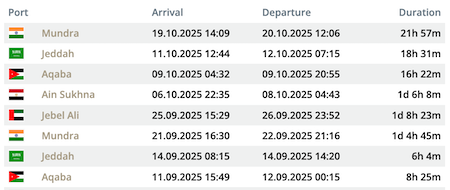
Latest ports
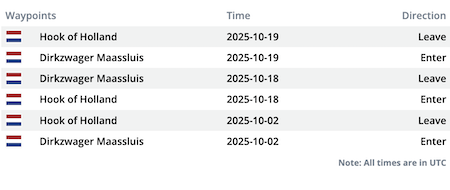
Latest Waypoints
Latest news
Report: Titan submersible operated with no federal oversight
The Transportation Safety Board of Canada found out that the submersible 'Titan', that imploded on Juine 18, 2023, on its way from the 'Polar Prince' down to the 'Titanic' wreck was operating in Canada without any oversight, and asked the federal authorities to look closer at uncertified vessels. The board released a report on June 17, 2026, examining the 'Titan's doomed voyage, which killed all five people on board. Among the dead was Stockton Rush, chief executive of OceanGate Inc., the Washington-based company that owned the small vessel. Transport Canada knew the uncertified submersible was operating out of St. John’s, N.L., but the department did not oversee those operations, leaving its occupants at risk. It also found that several other government agencies knew about the 'Titan'’s dives to the 'Titanic', but the information they shared with each other — and with Transport Canada — was limited. OceanGate often touted the 'Titan'’s unorthodox carbon-fibre hull, which was cylindrical rather than the standard sphere. The vessel was not “classed,” meaning it wasn’t certified by an independent third party to ensure it was conceived, constructed and tested according to safety standards. The safety board’s report said that OceanGate had no idea how long the hull would hold up under repeated dives to the bottom of the Atlantic. and the systems it had to test the structure were flawed or mismanaged. The 'Titan' began making trips to the 'Titanic' in 2021, and each trip likely damaged the hull until it finally imploded. OceanGate’s culture seemed to prevent any improvements. Officials in Canada weren’t asking about safety either. Transport Canada was aware of the 'Titan'’s trips. but it didn’t know the submersible was not registered with any flag state, and thus not beholden to any jurisdiction’s laws or regulations. Transport Canada never contacted OceanGate to ask about the 'Titan'’s safety standards, nor did it send officials to have a look at the vessel. The lack of regulatory oversight to identify safety deficiencies resulted in increased risk to those involved in the 'Titan'’s operations. The board recommended the department come up with a system to determine whether an uncertified vessel posed a safety risk and then monitor that vessel more closely. The move would make sea travel safer for thousands of other small uncertified vessels operating in Canada. Some small vessels can go through their entire life cycle without ever being inspected by a Transport Canada inspector. The report included five other recommendations about oversight, standards and safety management, including that Transport Canada push for mandatory international standards for designing, building and operating submersibles. The board provided the department with a briefing on the report before it was released. The department has 90 days to respond.
NTSB published report in loss of submersible Titan while descending from Polar Prince to Titanic
The National Transportation Safety Board has released its investigation report into the implosion of the submersible 'Titan' on June 18, 2023,, concluding that OceanGate’s inadequate engineering process and flawed analysis of monitoring data directly caused the catastrophic failure that killed all five persons aboard during a dive to the 'Titanic'. The submersible imploded at approximately 10:47 a.m. LT, while descending from the 'Polar Prince' to the wreckage, located about 372 miles southeast of St. John’s, at a depth of 3,880 meters. The implosion resulted in the immediate death of all occupants, including OceanGate’s CEO Stockton Rush, who were exposed to approximately 4,930 pounds per square inch of water pressure. The vessel was a total loss, valued at approximately $4.2 million. The NTSB found that the 'Titan'’s pressure vessel likely suffered damage after it surfaced at the end of dive 80 in the form of one or more delaminations that weakened the pressure vessel. After dive 82, the submersible sustained additional damage of unknown origin that further deteriorated the pressure vessel’s condition. OceanGate’s analysis of the 'Titan' pressure vessel real-time monitoring data was flawed, meaning that the company was unaware that the submersible was damaged and needed to be immediately removed from service after dive 80. The existing delaminations and additional damage that deteriorated the condition of the pressure vessel between dive 82 and the casualty dive resulted in a local buckling failure that led to the implosion. The NTSB determined that OceanGate’s engineering process for the 'Titan' was inadequate and resulted in the construction of a carbon fiber composite pressure vessel that contained multiple anomalies and failed to meet necessary strength and durability requirements. Because OceanGate did not adequately test the Titan, the company was unaware of the pressure vessel’s actual strength and durability, which was likely much lower than their target. The 22-foot-long submersible’s pressure vessel was constructed in 2020 and consisted of a thick-walled, carbon fiber-based composite cylinder fitted at each end with a titanium ring that was capped with a titanium dome. The titanium segments were glued to the cylinder, and the titanium domes were bolted to the segments. Had OceanGate followed Navigation and Vessel Inspection Circular 05-93 guidance for emergency response plans, they likely would have had emergency response assets standing by, and the 'Titan' likely would have been found sooner, saving time and resources even though a rescue was not possible in this case. Despite OceanGate’s failure to notify search and rescue assets about its planned expedition, as well as the limited resources able to operate at the depth of the 'Titanic', the US Coast Guard’s SAR coordination efforts were effective and resulted in the timely discovery of the wreckage. Voluntary guidance and current US small passenger vessel regulations were not sufficiently tailored to current pressure vessel for human occupancy operations to ensure safety in accordance with established technical and classification society standards. The NTSB determined that the probable cause of the hull failure and implosion was “OceanGate’s inadequate engineering process, which failed to establish the actual strength and durability of the Titan pressure vessel and resulted in the company operating a carbon fiber composite vessel that sustained delamination damage that was subsequently exacerbated by additional damage of unknown origin, resulting in a damaged internal structure that subsequently led to a local buckling failure of the pressure vessel.” Contributing factors included US and international voluntary guidance and US small passenger vessel regulations that were insufficient to ensure OceanGate adhered to established industry standards, as well as OceanGate’s flawed analysis of their pressure vessel monitoring system data. As a result of the investigation, the NTSB recommended that the US Coast Guard commission a panel of experts to study current pressure vessel for human occupancy operations and disseminate findings to industry. The board also recommended implementing US regulations for these vessels informed by the study findings and consistent with international requirements and guidance. Additional recommendations included updating NVIC 05-93 to include the revised definition of small passenger vessel as reflected in the Passenger Vessel Safety Act of 1993, and proposing that the International Maritime Organization make MSC.1/Circ. 981 mandatory to promote consistent application of pressure vessel for human occupancy rules among member states. The NTSB report followed the US Coast Guard Marine Board of Investigation’s comprehensive 300-page Report of Investigation released in August, which described the loss of the 'Titan' as “preventable” and resulting from multiple systemic failures at OceanGate. The Coast Guard investigation determined that the primary cause was the loss of structural integrity of the carbon fiber hull, with the probable failure point being either the adhesive joint between the forward dome and titanium segment, or the carbon fiber hull near the forward end of the submersible. According to the Coast Guard report, OceanGate strategically exploited regulatory gaps and confusion to operate the Titan completely outside established deep-sea protocols. The report states: “For several years preceding the incident, OceanGate leveraged intimidation tactics, allowances for scientific operations, and the company’s favorable reputation to evade regulatory scrutiny.” The Coast Guard investigation also highlighted OceanGate’s toxic workplace environment which used firings of senior staff members and the looming threat of being fired to dissuade employees and contractors from expressing safety concerns. Full report: https://www.ntsb.gov/investigations/Pages/DCA23FM036.aspx
U.S.C.G. Marine Board of Investigation (MBI) released Report of Investigation (ROI) into loss of submersible Titan
The U.S. Coast Guard Marine Board of Investigation (MBI) has released its Report of Investigation (ROI) on Aug 5 on the loss of the submersible 'Titan', which imploded during a June 2023 dive to the wreck of the 'Titanic', killing five people, after having been deployed from the 'Polar Prince' on June 18, 2023. The more than 300-page ROI outlines key findings and contributing factors in the casualty and includes 17 safety recommendations aimed at strengthening oversight of submersible operations, improving coordination among federal agencies and closing gaps in international maritime policy. The two-year investigation has identified multiple contributing factors that led to this tragedy, providing valuable lessons learned to prevent a future occurrence. There is a need for stronger oversight and clear options for operators who are exploring new concepts outside of the existing regulatory framework. The board determined the primary contributing factors were OceanGate’s inadequate design, certification, maintenance and inspection process for the Titan. Other factors cited in the report include a toxic workplace culture at OceanGate, an inadequate domestic and international regulatory framework for submersible operations and vessels of novel design, and an ineffective whistleblower process under the Seaman’s Protection Act. The board also found OceanGate failed to properly investigate and address known hull anomalies following its 2022 Titanic expedition. Investigators determined the Titan’s real-time monitoring system generated data that should have been analyzed and acted on during the 2022 'Titanic' expedition. However, OceanGate did not take any action related to the data, conduct any preventative maintenance or properly store the Titan during the extended off season before its 2023 'Titanic' expedition. The MBI recommendations included restricting the Oceanographic Research Vessel designations for submersibles, expanding federal and international requirements to all submersibles conducting scientific or commercial dives and requiring Coast Guard documentation for all U.S. submersibles. The board also recommended adding Coast Guard personnel capacity at Coast Guard Headquarters to support new construction oversight and field inspections involving submersibles and vessels of novel design. Further recommendations included requiring operators to submit dive and emergency response plans to the local Coast Guard officer in charge, marine inspection; evaluating the Coast Guard’s subsea search and rescue capabilities; and working with the International Maritime Organization to define passenger submersibles and expand international safety requirements for submersibles operating on the high seas. The board also called for a new Occupational Safety and Health Administration and Coast Guard agreement to clarify whistleblower investigative protocols and improve interagency coordination. The Marine Board's report is now under review by the Commandant of the Coast Guard. Upon completion of the review, the Commandant will issue a Final Action Memorandum confirming the U.S. Coast Guard's position on the recommendations and any actions to be pursued. Report with link to ROI: https://www.news.uscg.mil/Press-Releases/Article/4265651/coast-guard-marine-board-of-investigation-releases-report-on-titan-submersible/
Upload News